Thursday, June 10, 2010

DAY SEVENTEEN: ALL ART IS QUITE USELESS


Preface:-

The artist is the creator of beautiful things. To reveal art and conceal the artist is art's aim. The critic is he who can translate into another manner or a new material his impression of beautiful things. The highest as the lowest form of criticism is a mode of autobiography. Those who find ugly meanings in beautiful things are corrupt without being charming. This is a fault.

Those who find beautiful meanings in beautiful things are the cultivated. For these there is hope. They are the elect to whom beautiful things mean only beauty.

There is no such thing as a moral or an immoral book. Books are well written, or badly written. That is all.

The nineteenth century dislike of realism is the rage of Caliban seeing his own face in a glass.

The nineteenth century dislike of romanticism is the rage of Caliban not seeing his own face in a glass. The moral life of man forms part of the subject-matter of the artist, but the morality of art consists in the perfect use of an imperfect medium. No artist desires to prove anything. Even things that are true can be proved. No artist has ethical sympathies. An ethical sympathy in an artist is an unpardonable mannerism of style. No artist is ever morbid. The artist can express everything. Thought and language are to the artist instruments of an art. Vice and virtue are to the artist materials for an art. From the point of view of form, the type of all the arts is the art of the musician. From the point of view of feeling, the actor's craft is the type. All art is at once surface and symbol. Those who go beneath the surface do so at their peril. Those who read the symbol do so at their peril. It is the spectator, and not life, that art really mirrors. Diversity of opinion about a work of art shows that the work is new, complex, and vital. When critics disagree, the artist is in accord with himself. We can forgive a man for making a useful thing as long as he does not admire it. The only excuse for making a useless thing is that one admires it intensely.

All art is quite useless.

- OSCAR WILDE

DAY SIXTEEN: DIANE ARBUS


Diane Arbus was an American photographer and writer noted for black-and-white square photographs of "deviant and marginal people "(dwarfs, giants, transvestites, nudists, circus performers ) or else of people whose normality seems ugly or surreal to the normal eye. A friend said that Arbus said that she was "afraid... that she would be known simply as 'the photographer of freaks'; however, that term has been used repeatedly to describe her. This description of such a profound photographer stems from a fear from people who fail to understand the beauty in the unusual. These people are not freaks, they are extraordinary human beings.

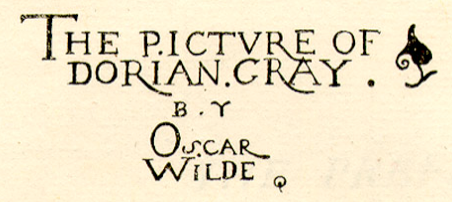
It is as Oscar Wilde states in the preface to the Picture of Dorian Gray; "The artist is the creator of beautiful things. To reveal art and conceal the artist is art's aim. The critic is he who can translate into another manner or a new material his impression of beautiful things.The highest as the lowest form of criticism is a mode of autobiography. Those who find ugly meanings in beautiful things are corrupt without being charming. This is a fault."

Arbus was outside of normality. She went above and beyond, breaking rules and conventions to become who she really was. This takes guts and a lot of strength, but sometimes you have to have to say "Fuck society, I'm going to do it my way." She did and she made a mark on the world.

TO FIND BEAUTIFUL MEANINGS IN BEAUTIFUL THINGS, CLICK HERE

DAY FIFTEEN: J'AI BAISE TA BOUCHE


Salomé is a tragedy by Oscar Wilde. The original 1891 version of the play was in French. Three years later an English translation was published. The play tells in one act the Biblical story of Salome, stepdaughter of the tetrach Herod Antipas, who, to her stepfather's dismay but to the delight of her mother Herodias, requests the head of Jokanaan (John the Baptist) on a silver platter as a reward for dancing the Dance of the Seven Veils.

These images above are from the first publication of Salome that was illustrated by Aubrey Beardsley. Beardsley was the most controversial artist of the Art Nouveau era, renowned for his dark and perverse images and the grotesque erotica, which were the main themes of his later work. Some of his drawings, inspired by Japanese shunga, featured enormous genitalia. His most famous erotic illustrations were on themes of history and mythology; these include his illustrations for a privately printed edition of Aristophanes' Lysistrata, and his drawings for Salome, which eventually premiered in Paris in 1896. The first image is of the climax of the play "J'ai baise ta bouche, Jokanaan; I kiss thy mouth, Jokanaan."


J'AI BAISE TA BOUCHE (HERE) XX

Thursday, May 27, 2010

DAY FOURTEEN: THE STRANGEST SHOP IN PARIS

I could not help but pat him if I saw him...He ain't gonna bite..

Private party, and you're not invited.

Preserve your cherished pets? No thanks...

Forget skeletons in the closet, how about a boar in the den?

“la boutique la plus étrange de Paris”

Paris has many unusual shops, but one of the most unusual has to be Deyrolle, a 170-year old establishment on rue du Bac, not far from the Musee d'Orsay on the Left Bank.

To describe it as a taxidermy shop hardly does it justice. The ground floor looks like a fairly ordinary small home and garden shop (apart from a couple of stuffed gazelles standing on their hind legs and dressed to look like humans). But walking up the stairs is like passing through a time warp. The second story (which in France is considered the first) appears to have changed little since the store moved to its current location in 1881. It's dusty, chaotic, and crammed with stuffed animals of all shapes, sizes, and poses, as well as ancient wooden cases full of insects, shells, botanical prints and a variety of curiosities.

As the pictures here suggest, it's really a museum masquerading as a store.

DEYROLLE
46 RUE DU BAC
PARIS 75007

Monday, May 17, 2010

DAY THIRTEEN: UNE SEMAINE DE BONTE


Une Semaine De Bonte trans. A Week of Kindness.

These strange, but true images are of the very real surreal from a book by Max Ernst of the above title. The Figure of the male as bird is interesting and creepy in his anonymity. Not something I would like to wake up to. Their beady eyes and long beaks - too much! But they are lovely things to look at. Macabre.

Une semaine de bonté comprises 182 images created by cutting up and re-organizing illustrations from Victorian novels, encyclopedias, and other books. Ernst arranged the images to present a dark, surreal world. Most of the seven sections have a distinct theme that unites the images within. In Sunday the element is mud, and Ernst's example for this element is the Lion of BelfortThe element of the next section, consequently, this section features numerous characters with lion heads. Monday, is water, and all of the images show water, either in a natural setting, or flowing inside bedrooms, dining rooms, etc. Some of the characters are able to walk on water, while others drown. The element associated with Tuesday is fire, and so most of the images in this section feature dragons or fantastic lizards. The last of the large sections, Wednesday, contains numerous images of bird-men.

The element of Thursday, "blackness", has two examples instead of one. The first example, "a rooster's laughter", is illustrated with more images of bird-men. The second example, Easter Island is illustrated with images portraying characters with Maoi heads. Friday, the most abstract part of the entire book, contains various images that resist categorization. They include collages of human bones and plants, one of which was used for the cardboard slipcase that was meant to house all five volumes of Une semaine de bonté. The final section of the book, Saturday, contains 10 images. The element given is "the key to songs"; the images are once again uncategorizable. The section, and with it the book, ends with several images of falling women.

No full interpretation of Une semaine de bonté has ever been published. The book, like its predecessors, has been described as projecting "recurrent themes of sexuality, anti-clericalism and violence, by dislocating the visual significance of the source material to suggest what has been repressed."

DAY TWELVE: DISCE MORI


The intrigue of taxidermy is explored through jewellery by artist Julia deVille. These beautiful pieces are inspired by Memento Mori jewellery of the fifteenth to eighteenth centuries and Victorian Mourning jewellery. DeVille combines traditional gold and silversmithing with materials that were once living such as jet, human hair and taxidermy. They are reminder of our mortality. These pieces are bizarre, but have a strange sense of beauty. It goes back to the Freudian theory of fascination and repulsion - we are afraid to look but want to see more, finding it hard to take our eyes away from them. I want one. Taxidermy is a celebration of life, a preservation of something beautiful...

WANT MORE? FOLLOW THE WHITE RABBIT

Monday, May 3, 2010

DAY ELEVEN: MEMENTO MORI

BRIEF HISTORY OF MEMENTO MORI
AND VICTORIAN MOURNING JEWELLERY


"Throughout the ages coffins, skeletons, and death heads (skull and cross-bones) have been used to symbolise the imminence of death and our own mortality.

Within the fourteenth century came the Bubonic Plague, which swept out some twenty five million people, one third of Europe by the beginning of the sixteenth century. Death was very much a part of every day life. Prior to this Death had been represented as the devil, horned and cloven-hoofed, forcing the sinful into the the mouth of hell. Between the fourteenth and fifteenth centuries Death began to take on a more familiar and human form, the skeleton, which was soon to appear in jewellery.

First rings were made with inscriptions such as; 'C'est mon ure' (my hour has come) and ESPOIRIER DE MY SANS FYNE (Pray for me always), to remind the wearer of the approach of death and the need to prepare for it. "

WANT TO READ MORE? CLICK HERE FOR DISCE MORI